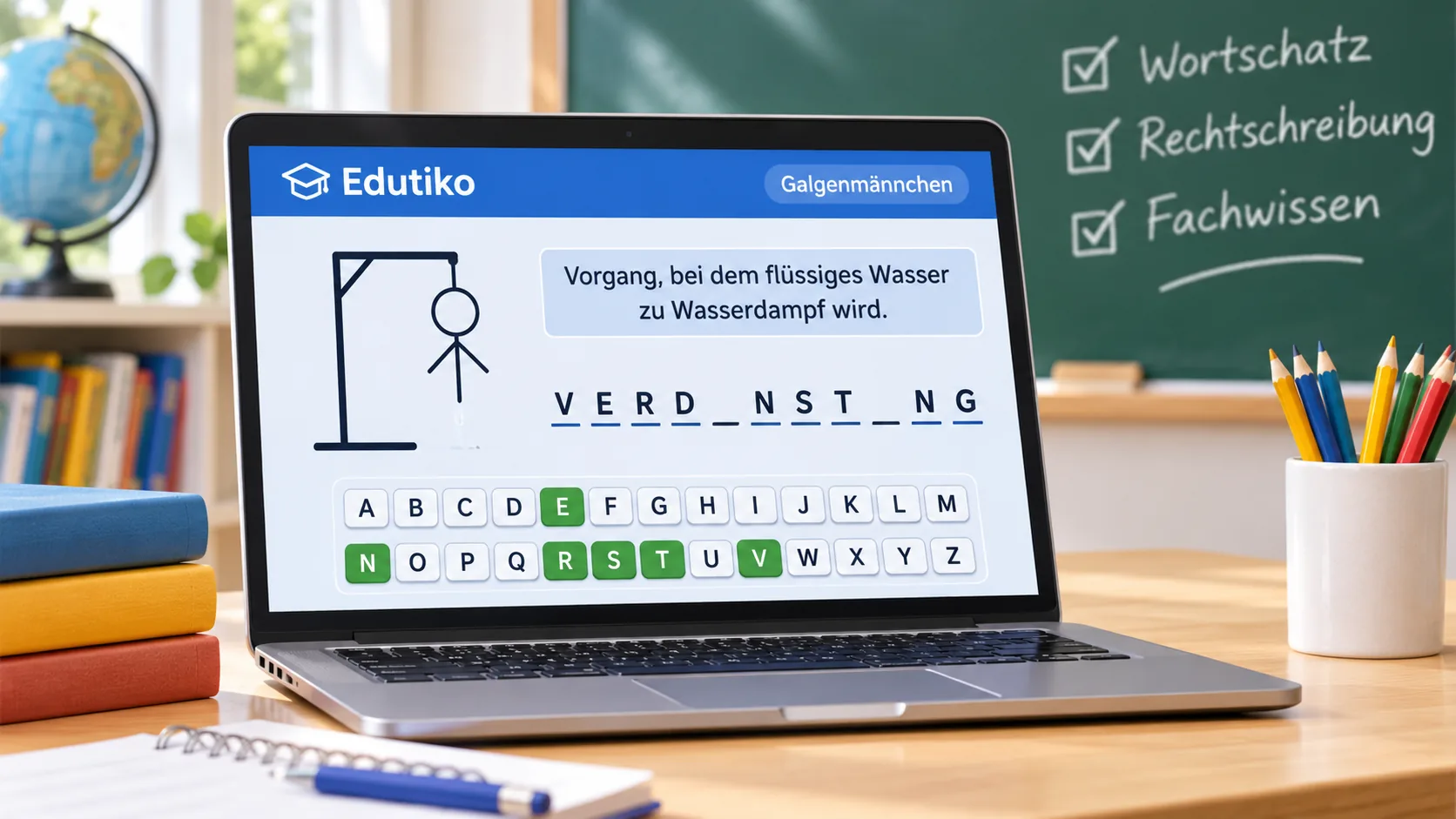
You’ve spent the week introducing ten new words. Your students can recognise them in their textbooks, but when you ask them to spell the words or explain their meanings without looking at their notes, the hesitation begins.
Some remember what a word means but struggle to spell it. Others can recall the first few letters but cannot finish it.
This is where educational hangman can become a useful short classroom activity. When thoughtfully designed, it gives students an opportunity to retrieve vocabulary, pay attention to spelling and reveal which terms still need practice.
The important part is giving the game a clear learning purpose.
Simply guessing letters until a word appears is not enough. The educational value comes from the words you select, the clues you provide and what students do once they have solved each word.
Here’s how to turn a familiar word game into meaningful classroom practice.
What Is Educational Hangman?
Hangman is a word-guessing game in which players try to uncover a hidden word by suggesting letters.
In educational hangman, the words are chosen to match what students are learning. They might be spelling words, subject-specific vocabulary, scientific concepts, geographical terms or expressions from a foreign language.
The basic game stays the same, but the purpose changes.
Instead of choosing random words, the teacher selects terms that students need to remember and use.
For example, imagine a science class reviewing plant biology. You give students this clue:
“The process by which plants use light energy to make food.”
The hidden word is PHOTOSYNTHESIS.
Uncovering the letters can help students recall the written form of the term. But once they solve it, ask someone to explain the process in their own words.
That extra step turns a guessing game into an opportunity to check understanding.
Three Learning Goals to Keep Separate
Educational hangman can support different goals, but they require slightly different follow-up tasks.
| Learning goal | What students practise | Example | |—|—|—| | Vocabulary | Recalling a word from its meaning | “An instrument used to measure temperature” → THERMOMETER | | Spelling | Remembering the correct written form | Words such as NECESSARY, SEPARATE and BELIEVE | | Subject knowledge | Connecting a term to a concept | “Liquid water changing into water vapour” → EVAPORATION |
Before preparing your game, decide which goal matters most.
If students need to understand a complex scientific process, solving a word will not demonstrate that understanding on its own. You’ll need an additional question, example or explanation.
How to Prepare an Educational Hangman Activity
You don’t need a full lesson devoted to the game.
A short activity with a few carefully chosen words can work well at the beginning or end of a lesson.
1. Choose Words That Match Your Learning Objective
Start with the material students have already encountered.
If your class has been studying changes of state, you might select:
- Evaporation
- Condensation
- Freezing
- Melting
- Sublimation
These words belong to the same topic, but they describe different processes. That makes them useful not only for spelling practice but also for checking whether students can distinguish related concepts.
Try to avoid introducing a long list of unfamiliar terms through hangman alone.
Students should have a reasonable chance to retrieve the words. The game is most useful when it provides practice with knowledge that has already been taught.
2. Write Clues That Encourage Thinking
A clue such as “It has twelve letters” tells students something about the word’s appearance, but very little about its meaning.
A more useful clue would be:
“The process in which water vapour changes into liquid water.”
Answer: CONDENSATION
Now students have a reason to think about the science before they start guessing letters.
For vocabulary practice, clues can include definitions, real-life examples or short descriptions.
For spelling practice, you might combine a meaning-based clue with a reminder about the word’s structure.
The aim is to make guessing depend on knowledge rather than luck.
3. Match the Difficulty to Your Students
Some words are much harder to solve than others.
Consider their length, familiarity, spelling patterns and the clues students will need.
Here is a simple progression:
| Level | Clue | Answer | |—|—|—| | Beginner | “A pet that purrs” | CAT | | Intermediate | “A place where people can borrow books” | LIBRARY | | Advanced | “The process by which an organism maintains relatively stable internal conditions” | HOMEOSTASIS |
The advanced example involves more than a longer word. Students also need to recall an abstract concept.
Avoid making words difficult simply to make the game more challenging. If the term is too unfamiliar, students may spend the entire round guessing common letters without engaging with the subject.
4. Make Participation More Inclusive
In a whole-class game, the fastest students can easily dominate.
One way to avoid this is to let students discuss a possible answer with a partner before choosing a letter.
You can also ask everyone to write down their best guess, even when the hidden word is only partly revealed.
This allows you to hear from more than the students who raise their hands first.
If you use teams, make sure the activity remains collaborative and that students who need more thinking time have a role.
Competition is optional. Learning the vocabulary is the priority.
5. Follow Every Word With a Learning Check
This is one of the most important decisions in the activity.
When the word is solved, resist the temptation to move straight to the next one.
Ask students to do something with it.
Depending on your goal, they could:
- Explain the meaning.
- Spell the word without looking.
- Use it correctly in a sentence.
- Identify a tricky spelling pattern.
- Compare it with another term.
For example, after solving CONDENSATION, ask:
“How is condensation different from evaporation?”
The answer tells you considerably more about students’ understanding than the completed word alone.
Five Educational Hangman Activities for Different Subjects
The same game can support different types of classroom practice.
Here are five practical approaches.
1. Spelling Practice: Commonly Misspelled Words
Choose words that contain spelling patterns your students have been studying.
For an English spelling lesson, you could use:
NECESSARY, SEPARATE, BELIEVE, RECEIVE, FRIEND
Provide a meaning-based clue or put each word in a sentence without showing it.
Once students uncover a word, ask them to close or look away from the game and write it independently.
Then review the spelling together.
For example:
“She believes that regular practice helps her improve.”
Draw attention to the spelling of BELIEVE, but avoid presenting a single spelling rule as if it applied to every English word.
Teaching tip: recognising letters as they appear is not the same as spelling a word independently. Always include a short writing task if spelling accuracy is your main objective.
2. English Language Learning: Vocabulary From Definitions
For students learning English as an additional language, hangman can provide practice with familiar classroom vocabulary.
Try clues such as:
- “You use it to write on paper” → PENCIL.
- “You read it to follow a story” → BOOK.
- “You use it to remove pencil marks” → ERASER.
These clues help students retrieve words without immediately showing a translation.
Once the word is solved, ask for a sentence:
“I have a pencil in my bag.”
If your lesson also focuses on pronunciation, have students say the word and practise it with an appropriate spoken model.
Knowing how a word is spelled does not necessarily mean knowing how to pronounce it.
3. Science: Guess the Concept From Its Definition
Suppose your class has been learning about changes of state.
You could prepare three words:
MELTING
Clue: “The change from a solid to a liquid.”
CONDENSATION
Clue: “The change from a gas to a liquid.”
EVAPORATION
Clue: “The process in which a liquid changes into a gas at its surface.”
After the game, ask students to match each word with an everyday example:
- An ice cube turning into water.
- Water droplets forming on a cold glass.
- Wet clothes drying on a washing line.
This follow-up helps you check whether students can apply the concepts rather than merely recognise their names.
4. History and Geography: Key Terms From a Unit
Educational hangman can help students retrieve important vocabulary in History and Geography.
In Geography, you might give this clue:
“The imaginary line around the middle of the Earth that divides it into the Northern and Southern Hemispheres.”
Answer: EQUATOR
After solving it, ask students to locate the Equator on a map.
In History, try:
“The process of developing industries and large-scale manufacturing.”
Answer: INDUSTRIALISATION
Then ask what changes industrialisation brought to work or urban life.
For students using American English, you can use INDUSTRIALIZATION instead. Choose one spelling convention consistently.
The hidden term should start the discussion, not replace it.
5. Academic Vocabulary: Words Students Need Across Subjects
Some students understand a topic but struggle with the instructions used in assignments and assessments.
Words such as these appear in many subjects:
COMPARE, INFER, JUSTIFY, SUMMARISE, ARGUE
Use a simple definition as the clue.
After solving JUSTIFY, ask:
“What is the difference between giving an answer and justifying it?”
After COMPARE, ask students to identify one similarity and one difference between two objects, events or ideas.
These additional tasks help connect the vocabulary to actual classroom use.
A Ten-Minute Educational Hangman Routine
Educational hangman does not need to take over your lesson.
Here is one possible ten-minute structure:
| Time | Activity | |—|—| | Minutes 1–2 | Explain the objective and remind students of the rules | | Minutes 3–6 | Play three words connected to the topic | | Minutes 7–8 | Ask students to explain or apply two of the words | | Minutes 9–10 | Check individual recall without displaying the answers |
Imagine you are reviewing ecosystems.
The three hidden words are:
PREDATOR, PREY, HABITAT
After the game, students answer two questions individually:
“What is the relationship between a predator and its prey?”
“How is a habitat different from an ecosystem?”
Their answers can help you decide whether to move on or revisit particular ideas.
Ten minutes is only a suggested starting point. Adjust the timing to suit the age of your students, the complexity of the vocabulary and the size of your class.
What Does Educational Hangman Actually Help Students Learn?
Educational hangman can create opportunities to retrieve vocabulary and notice spelling.
But it is important not to confuse the game itself with a proven learning outcome.
Research on retrieval practice suggests that trying to recall previously learned information can support learning. However, the Education Endowment Foundation has highlighted an important distinction between evidence supporting retrieval practice and evidence about how effectively teachers can implement it in everyday lessons.
That distinction matters here.
We should not claim that simply playing hangman automatically improves spelling, vocabulary retention or subject understanding.
Three limitations deserve particular attention.
Guessing Letters Is Not the Same as Knowing a Definition
A student might uncover a word by trying common vowels and consonants.
That does not show they understand its meaning.
Use clues connected to the lesson and ask for an explanation after the word is solved.
Recognising a Spelling Is Not the Same as Producing It
As correct letters appear, the word becomes easier to recognise.
But if your objective is spelling, ask students to write it again without looking at the completed answer.
Solving a Word Is Not the Same as Understanding a Topic
A student may correctly identify PHOTOSYNTHESIS without being able to describe how plants use light energy.
If your objective is conceptual understanding, include explanations, examples or application questions.
The educational value lies in how the teacher designs and follows up the activity, not just in the mechanics of the game.
Common Mistakes to Avoid
Choosing Words That Are Too Difficult
Students who have never encountered a word may have little choice but to guess randomly.
Instead: begin with familiar terms and increase the challenge gradually.
Providing No Meaningful Clues
Without useful clues, the game can become a test of letter-guessing strategies rather than vocabulary knowledge.
Instead: use definitions, examples or descriptions related to the topic.
Letting the Same Students Answer Every Time
Fast-paced competition can leave quieter students out.
Instead: include partner discussion, thinking time or individual predictions.
Playing for Too Long
A game can be enjoyable while still taking more lesson time than its learning value justifies.
Instead: use a small number of high-priority words and save time for follow-up questions.
Treating Enthusiasm as Evidence of Understanding
Active participation is encouraging, but it does not prove that students have mastered the material.
Instead: finish with a short independent task.
How to Adapt Hangman for Different Ages and Abilities
With younger students or beginners, choose familiar words, straightforward clues and only a few rounds.
With older students, use subject-specific vocabulary and questions that require more precise explanations.
In a mixed-ability class, you can keep the same hidden word but vary the support you provide.
For example, the target word is EVAPORATION.
More support:
“The process in which liquid water changes into water vapour.”
Moderate support:
“A change of state from liquid to gas that can happen at the surface of a liquid.”
Greater challenge:
“What process allows wet clothes to dry even when the water does not reach its boiling point?”
All three clues lead to the same word, but they place different demands on students’ understanding.
You might also let students refer to a word bank during early rounds and gradually remove that support.
The aim is not to make every student experience exactly the same level of difficulty. It is to help everyone practise the knowledge they need.
How to Use Educational Hangman With Edutiko
Once you have chosen your words and planned the clues, you can bring the activity into a digital game.
Edutiko offers an educational version of Hangman that can be used for classroom word games and vocabulary practice.
If you are introducing Edutiko to a teacher who has never used it before, the most useful first step is to try the public demo.
That lets the teacher experience the game before deciding whether to register and prepare personalised classroom activities.
Before using hangman with students, consider these five questions:
- Do the hidden words match the learning objective?
- Are the clues accurate and suitable for the students’ level?
- Have you checked the spelling of every answer?
- Will all students have an opportunity to participate?
- What question or task will follow each solved word?
You do not need a competitive format. The activity can also work as a collaborative review in which students explain their thinking.
Try Edutiko’s Educational Hangman Demo
When Hangman Is the Right Choice—and When It Isn’t
Educational hangman can work well when students need to recall words, practise spelling patterns or connect vocabulary with definitions.
It is less suitable when your main objective is to observe extended reasoning or a complex explanation.
| If students need to… | Consider using… | |—|—| | Recall previously taught words | Hangman with meaningful clues | | Practise spelling independently | Hangman followed by a written spelling check | | Match terms and meanings | A matching-columns activity | | Explain a complicated idea | An open-ended question or guided discussion | | Answer several questions about a topic | A classroom quiz | | Arrange a sentence correctly | A word-ordering activity |
Choose the activity based on what you want students to demonstrate, not just which game looks most entertaining.
You can also combine approaches: start with hangman to reactivate vocabulary and move on to an exercise that requires students to use those words in context.
Frequently Asked Questions
What age group is educational hangman suitable for?
It can be adapted for different ages. Younger learners generally benefit from familiar, shorter words and simple clues. Older students can work with longer subject-specific terms and more demanding follow-up questions.
Can hangman help students practise spelling?
It can form part of spelling practice, particularly when students are reviewing words they have already learned. However, it should be followed by an independent spelling task if the objective is to check whether they can write the words correctly.
How many words should I include in one game?
There is no universal number. For a short classroom activity, three or four carefully chosen terms may be enough. Include more only if you can still make time to discuss and check the answers.
Is educational hangman useful for English language learners?
Yes, it can provide opportunities to retrieve familiar vocabulary from definitions or context clues. Additional sentence-writing and speaking activities are useful when the goal includes word usage or pronunciation.
Should students play individually or in teams?
Both approaches have advantages. Teams can encourage discussion and collaboration. Individual responses provide clearer evidence of what each student remembers. You can combine them in the same lesson.
How can I tell whether students have learned the words?
Ask them to explain a meaning, spell the word without looking or use it correctly in a new example. These responses offer information that solving the hidden letters alone does not provide.
Make Every Word Count
Educational hangman works best when every word has a purpose.
Choose vocabulary that students genuinely need to remember, offer clues connected to its meaning and make sure everyone has time to think.
After a word is solved, ask students to explain it, spell it independently or use it in a new context.
Then finish with a brief check of what they can remember without the game on screen.
You do not need a long game or an enormous word list.
Three well-chosen words followed by thoughtful questions can offer more useful classroom practice than twenty words guessed without discussion.