The test is only a few days away. You’ve finished teaching the unit, but when you ask students about the key concepts, the same few hands go up every time. Others seem to recognize answers when they see them in their textbooks but struggle to recall them without help.
In this situation, teaching the entire unit again isn’t always the best solution. What you need is a clearer picture of what students remember, what they’re confusing, and what they should practise before the assessment.
Educational review games can help you achieve this without turning the final lesson into a repetitive series of worksheets. The key isn’t playing games for their own sake. It’s designing activities that encourage students to retrieve knowledge, explain their answers, and learn from mistakes.
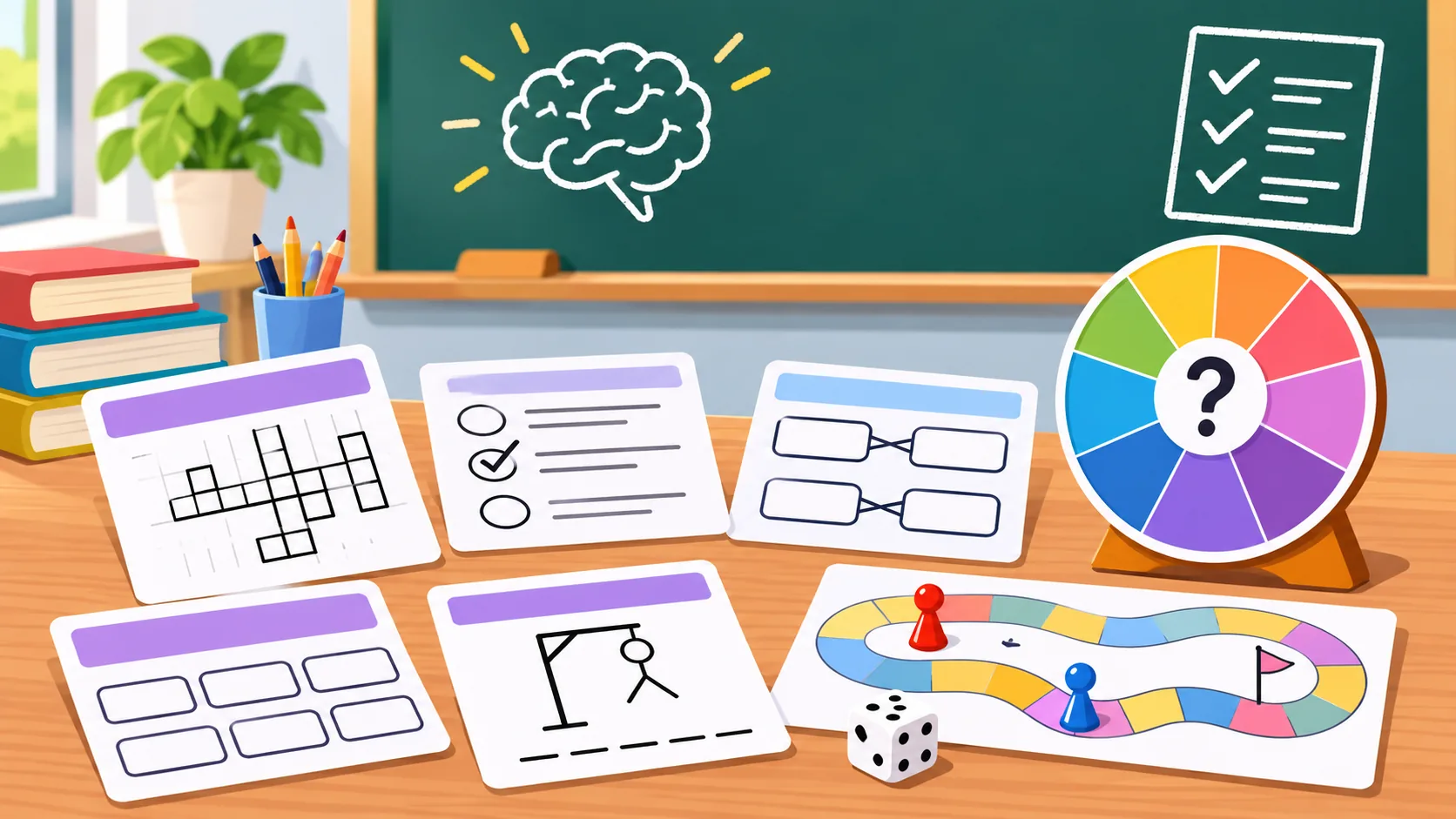
Below are seven classroom activities for different subjects, complete with examples, suggested timings, and practical advice for making review sessions more effective.
Why use educational games before a test?
A useful review activity gives students a chance to recall what they’ve learned, check their answers, and identify what they still need to work on.
For example, reading a definition five times can create a sense of familiarity. Explaining that definition without looking at the textbook, however, requires students to retrieve information from memory.
Research on effective learning techniques has found support for retrieval practice and spreading study sessions over time. In their review of learning strategies, Dunlosky and colleagues identified practice testing and distributed practice as particularly useful across a range of educational settings.
That doesn’t mean every classroom game automatically improves learning. A multiple-choice activity with overly obvious answers may make a lesson lively while revealing very little about what students can remember independently.
To make review activities worthwhile, focus on three principles:
- Retrieve before checking: Ask students to try answering without their notes first.
- Correct and explain: Check responses and discuss why mistakes occurred.
- Return to difficult material: Revisit challenging concepts in a later session.
Games can provide an engaging structure for these steps. The teacher still decides what students practise, when they practise it, and how challenging the questions should be.
7 educational review games to try in class
1. Crossword puzzles for key vocabulary
Best for: Subject-specific terminology, definitions, historical events, scientific concepts, and parts of a system.
Suggested time: 8–12 minutes.
Crossword puzzles are useful when students need to understand and accurately use important terms. The goal shouldn’t simply be filling in boxes; clues should encourage students to interpret the meaning of each concept.
Science example
Topic: Ecosystems.
Try clues such as:
- An organism that makes its own food through photosynthesis. Answer: producer.
- A relationship in which one organism benefits while the other is harmed. Answer: parasitism.
- Populations of different species living in the same area. Answer: community.
After completing the crossword, ask each pair of students to select two terms and explain how they relate to the topic.
This helps you check both vocabulary knowledge and conceptual understanding.
You can create this type of activity with Edutiko’s Crossword tool.
Common mistake: Making clues so obvious that students can solve them by counting letters alone. Include some clues that require genuine understanding.
2. A quiz that exposes common misconceptions
Best for: Reviewing several topics, identifying misunderstandings, and checking knowledge before an assessment.
Suggested time: 10 minutes.
A quiz can serve as a quick diagnostic activity. To make it effective, avoid questions where the correct answer is immediately obvious.
Instead, include distractors based on mistakes students commonly make.
Maths example
Question: What is the result of 3 + 2 × 4?
- A) 20
- B) 11
- C) 24
- D) 14
The correct answer is 11 because multiplication comes before addition.
The most valuable part comes after students respond:
Ask why someone might have chosen 20.
An incorrect answer then becomes an opportunity to discuss the order of operations.
Teaching tip: Combine recall, application, and explanation questions. If every question only tests recognition, you may overestimate how well students understand the material.
3. Matching activities for connecting ideas
Best for: Concepts and examples, causes and consequences, writers and works, dates and historical events.
Suggested time: 5–8 minutes.
Matching exercises may look simple, but their difficulty depends on the relationships students need to identify.
A basic history activity might include:
- Industrial Revolution → Transformation of production systems.
- Enlightenment → Intellectual movement emphasizing reason and critical thinking.
- French Revolution → Political and social upheaval beginning in France in 1789.
To make the activity more challenging, replace some definitions with real situations students must interpret.
Suggested classroom routine
First, students match the items independently. Then they compare answers with a partner and explain at least two of their choices.
When partners disagree, both must justify their reasoning based on the lesson.
This second stage prevents the task from becoming an exercise in guessing.
4. Unscrambling words to rebuild ideas
Best for: Language learning, scientific explanations, logical relationships, and sentence construction.
Suggested time: 5–10 minutes.
Give students a set of words in the wrong order and ask them to reconstruct a meaningful sentence.
English language example
Words: “subject / agrees / the / verb / with / the”
Answer: “The verb agrees with the subject.”
After arranging the words, students produce their own sentence demonstrating subject–verb agreement.
Science example
Words: “energy / sunlight / plants / from / use”
Answer: “Plants use energy from sunlight.”
Students then explain how sunlight contributes to photosynthesis.
This activity is particularly helpful when an exam requires students to express ideas accurately. Rebuilding the sentence is the starting point; explaining it helps demonstrate understanding.
5. Educational hangman for vocabulary recall
Best for: Spelling, language learning, terminology, and words students need to write accurately.
Suggested time: 5–8 minutes.
Hangman can work as a review game when the objective goes beyond guessing letters.
Geography example
Choose the word “archipelago”.
Before starting, provide a meaningful clue: “A group of islands located near one another.”
Students suggest letters. Once the word is revealed, ask them to:
- Define it in their own words.
- Give a geographical example.
- Explain how an archipelago differs from a single island.
This combines vocabulary practice with conceptual understanding.
When not to use it: When you need to assess complex reasoning. Guessing a word doesn’t necessarily show that a student can solve a problem or explain a process.
6. A question wheel with structured participation
Best for: Oral review, quick retrieval practice, and revisiting different parts of a unit.
Suggested time: 8–10 minutes.
Prepare a question wheel with categories linked to the topic:
- Key concepts.
- Examples.
- Explain why.
- Spot the mistake.
- Apply your knowledge.
Each category leads to a short question or challenge.
Social studies example
Category: “Spot the mistake.”
Statement: “Every country in Europe uses the euro.”
Students explain why the statement is incorrect and provide a counterexample.
To involve the whole class, ask everyone to write an answer before selecting someone to speak.
That way, students who aren’t answering aloud still have to think about the question.
Important: Avoid using the wheel to put struggling students on the spot. Offer thinking time, partner discussion, or a written response first.
7. A board game to bring the whole unit together
Best for: End-of-unit review, cooperative learning, and combining different types of questions.
Suggested time: 15–20 minutes.
A Goose Game-style board activity can organize a sequence of challenges combining recall, reasoning, and short tasks.
Each square might ask students to:
- Answer a question from the unit.
- Explain a concept without using a particular word.
- Correct an inaccurate statement.
- Solve a short problem.
- Match an example with its explanation.
History review example
One square asks for a cause of an event. Another requires students to put three events in chronological order. A third asks them to explain and justify a consequence.
This variety prevents every turn from becoming the same type of question.
Teaching tip: Set a fixed time limit and make sure moving around the board doesn’t become more important than learning. When students get something wrong, explain the answer and offer another opportunity to try.
How to organize a 20-minute review lesson
You don’t need to use all seven games in one session. In fact, two or three activities with different purposes are usually more manageable.
Here’s an example for a class preparing for a test:
| Time | Activity | Purpose | |—|—|—| | 0–3 min | Three individual questions without notes | Check what students remember | | 3–10 min | Quiz based on common mistakes | Identify misconceptions | | 10–16 min | Crossword or matching activity | Strengthen vocabulary and connections | | 16–20 min | Final explanation and exit question | Decide what needs more practice |
For the final question, ask:
“What topic would you still struggle to explain without help?”
Encourage specific responses. “I can’t remember how to solve equations with brackets” is much more useful than “I’m bad at maths.”
Collect the most common difficulties and use them to plan what to revisit in the next lesson.
If you’re also looking for ways to improve motivation and participation, explore our guide to gamification in education, which explains how to introduce game elements without losing sight of learning goals.
How to choose a review game for the type of test
The assessment format matters. A good review activity should practise the knowledge and thinking processes students will need later.
| If the test requires students to… | Recommended review activity | |—|—| | Recall terms and definitions | Crossword or hangman | | Identify correct answers and common mistakes | Quiz | | Connect ideas, causes, or examples | Matching activity | | Construct sentences or definitions | Unscrambling words | | Explain material aloud | Question wheel | | Bring together several parts of a unit | Goose Game-style board activity |
Use this as guidance rather than a strict rule.
If students will have to solve open-ended problems, a four-option quiz shouldn’t be their only preparation. They also need practice completing solutions and explaining their reasoning.
Likewise, if the exam includes writing or argumentation, provide questions that require students to produce their own answers.
Four common mistakes when planning review games
Turning the lesson into a speed competition
Answering first isn’t the same as understanding best.
When speed dominates, students who need more thinking time may participate less, and others may rush into answers without reasoning.
A better approach: Give everyone time to think and reward explanations, not just quick responses.
Making every question too easy
If all the answers are obvious, students may finish feeling more prepared than they actually are.
Include questions requiring them to distinguish similar concepts, justify decisions, and apply knowledge in unfamiliar situations.
Skipping feedback after mistakes
An incorrect answer reveals a difficulty, but it doesn’t automatically resolve it.
Take time to explain the mistake and, where appropriate, ask a similar question to check understanding again.
The Education Endowment Foundation emphasizes the importance of feedback that helps identify and address learning difficulties.
Saving all the games for the day before the test
One intensive review session can help identify gaps, but it doesn’t replace learning spread over several days.
Whenever possible, include short retrieval activities throughout the unit rather than only at the end.
How to adapt review games to different ability levels
In the same classroom, some students may know the definitions confidently while others still confuse basic concepts.
You don’t need to prepare seven completely different games.
Instead, use the same format with challenges at different levels.
For example, in a lesson about the solar system:
- Support level: Match planets with key characteristics.
- Intermediate level: Answer questions without referring to notes.
- Extension level: Explain why a statement about planetary movement is incorrect.
You can also offer graduated clues, extra thinking time, or an initial pair-work stage.
The purpose of differentiation is to help everyone practise, not to rank students publicly.
From review games to an individual practice test
Games can reveal what students find difficult, but it’s useful to end the process with individual questions completed without support.
For example, after reviewing ecosystems through a crossword and a quiz, try these three questions:
- Define a producer in an ecosystem.
- Explain one difference between parasitism and predation.
- Describe what might happen if a species disappeared from a food chain.
These questions assess more than recognizing terms. They show whether students can explain relationships and apply concepts.
They can also help you decide whether part of the unit needs reteaching or whether students are ready to move forward.
Plan your next classroom review with Edutiko
You don’t need to turn every lesson into a game to make review more effective. Start by identifying two or three concepts students should be able to recall independently.
Then choose an activity that lets them practise those concepts, observe common mistakes, and reserve a few minutes to discuss the answers.
Edutiko offers different ways to organize classroom review activities, including crossword puzzles, question-based games, and other formats connected to your teaching content.
Explore Edutiko’s educational games
The most useful activity isn’t necessarily the most entertaining. It’s the one that helps you discover what students know, correct misunderstandings, and decide what they should practise before the test.
Frequently asked questions about classroom review games
How many review games should I use before a test?
It depends on your available time and learning goals. For a short session, two complementary activities may be enough: one for recalling knowledge and another for applying or explaining it.
Can educational games replace individual study?
No. They can support retrieval practice, create opportunities for feedback, and reveal misconceptions, but students also need individual practice with the tasks they’ll complete during the test.
Which game is best for reviewing vocabulary?
Crosswords and hangman can help students practise terminology and spelling. To check understanding, follow up with definitions, examples, or explanations rather than stopping when they guess the word.
How can I tell whether a review game helped students learn?
Participation and enthusiasm aren’t sufficient evidence. After the activity, ask one or two individual questions without support and check whether students can recall and explain the material.
Are these games suitable for secondary school?
Yes, provided the questions and format match students’ age and the subject’s complexity. The learning objective matters more than whether a game looks childish or sophisticated.
What should I do if many students get the same question wrong?
Identify the underlying misconception, explain the difference using examples, and check again with a new question. You don’t need to repeat the entire game if the difficulty is specific.